meNexus
Your identity is portable. Your community is sovereign.
A decentralized social layer where communities run their own configurable Synapse nodes, with modular capabilities and peer-to-peer communication.
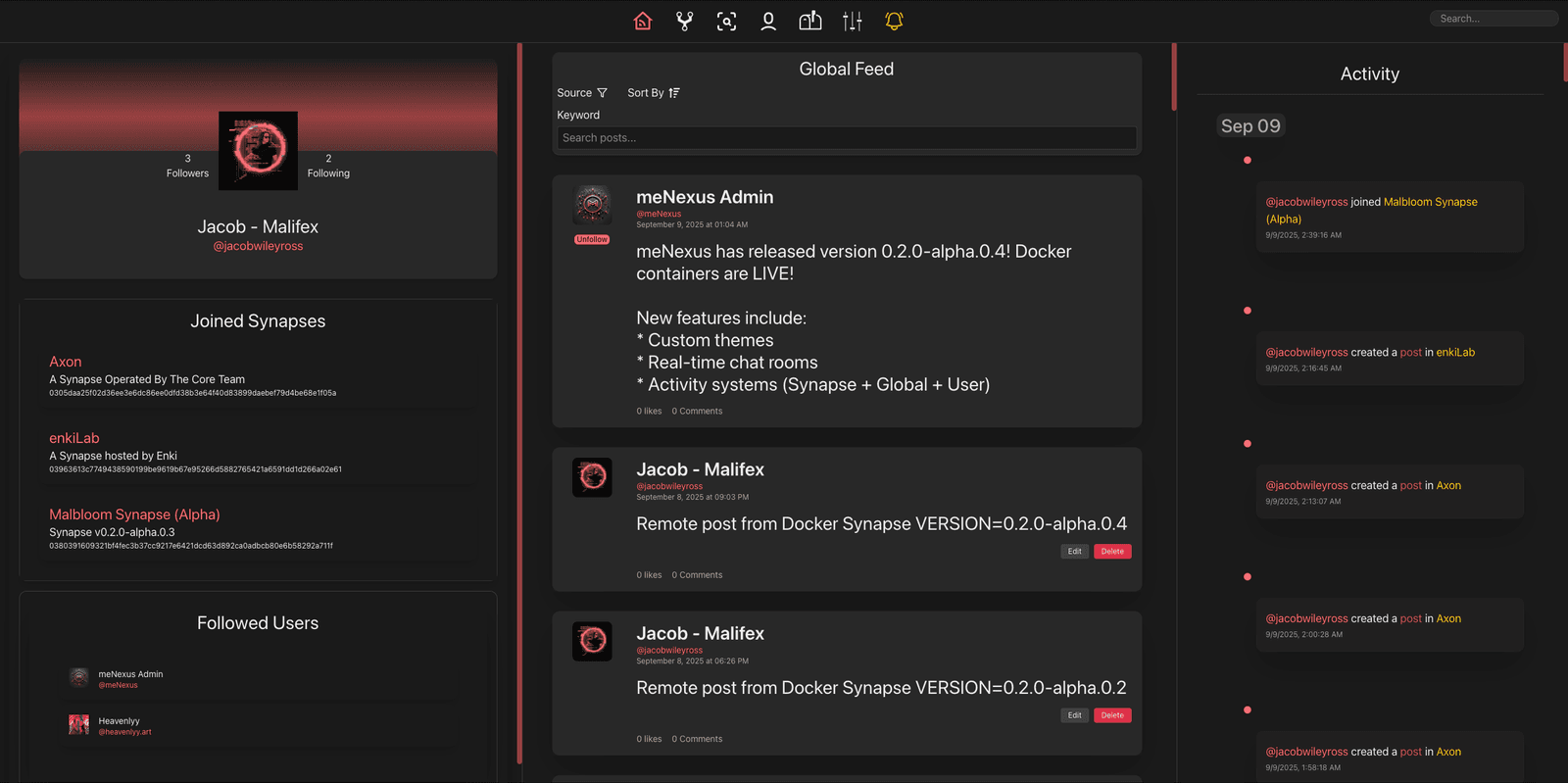
Overview / the idea
meNexus gives communities their own Synapse: an autonomous, configurable node that can communicate with other nodes in the network. Its direction centers on portable identity, community autonomy, and ownership of data. The platform is in early alpha. The core architecture and federation are evolving, and several modules are UI previews while their backend integration develops.
Capabilities / what makes it tick
Community-operated nodes
Each Synapse is an independent, configurable home for a community.
A modular foundation
A hexagonal architecture separates domain types, application orchestration, modules, and adapters.
Portable identity and P2P
The architecture combines cryptographic identity with libp2p networking and a Rust web stack.
Dependencies / stack
- Rust
- Leptos
- WebAssembly
- Axum
- Tokio
- libp2p
- PostgreSQL
My contribution
Software Engineer
Case study / under the surface
Communities as independent nodes
A Synapse is the core unit of meNexus: an autonomous node configured by the community that runs it. This creates room for different communities to choose their own experience while participating in a wider peer-to-peer network.
A composable Rust architecture
The project uses Axum for its server and Leptos for its web interface, with WebAssembly and server-side rendering. The architecture separates a core domain, an application orchestration layer, feature modules, and adapters for PostgreSQL and libp2p. Tokio provides the asynchronous runtime.
An evolving platform
The public repository describes meNexus as early alpha. Posts are functional but incomplete, while chat, members, activity, and livestream modules are currently presented as UI previews with backend wiring in progress. The development-focused setup reflects that stage of the project.
Continue exploring